
Collaborative robots, or cobots, are reshaping how we interact with machines. Designed to operate safely in shared environments, AI-enabled cobots are now embedded across manufacturing, logistics, healthcare, and even the home. But their role goes beyond automation—they are collaborative partners, built to adapt, understand, and make decisions in real-time.
Unlike legacy robots designed for isolated, repetitive tasks, cobots are purpose-built for fluid engagement in dynamic, unpredictable settings. This demands more than mechanical precision; it requires real-time perception, contextual understanding, and continuous learning. All of which are made possible by AI.
The Limits of Traditional Robots
Traditional robots thrive in structured environments where variables are fixed. But the moment conditions shift—a person walks into the robot’s path, an object changes position, or a task varies—these systems falter. Their behavior is hard-coded, and modifying it often requires manual reprogramming.
Cobots, by contrast, are able to adeptly handle complexity on the fly. They can interpret sensor data, understand spoken commands, identify objects, and make split-second decisions based on human behavior and proximity. Whether adjusting to a worker’s unexpected movement or adapting to a new task on the fly, cobots are designed to handle the messiness of real-world environments—without needing to be reprogrammed for each change.
Safety Through Intelligence

Safety is central to the cobot design philosophy. Working in close proximity to humans means cobots must perceive, anticipate, and respond to potential hazards in real-time. This includes slowing down when a person enters their workspace, pausing operations if a collision seems imminent, or rerouting to avoid obstacles.
AI makes these safety behaviors possible. With on-device computer vision, cobots can detect human limbs, monitor proximity, and adapt accordingly. Reinforcement learning enables them to refine responses over time—reacting faster to familiar situations and adjusting to new ones as they emerge.
In healthcare, this might mean recognizing and responding to a patient’s fall. In industrial settings, it could involve adapting to irregular part placement on a fast-moving assembly line. These capabilities aren’t the product of predefined rules; they’re powered by continual learning and context-aware perception.
Flexibility in Unstructured Environments
One of the most important recent on-device advancements in AI-enabled cobots is GenAI-enabled versatility. With lightweight vision-language models (VLMs) and speech recognition, cobots can follow natural-language instructions like “bring the red box to station A” without relying on rigid programming.
Perception, speech and vision-language models allow cobots to analyze what they see and hear and convert that analysis into actions—with or without the need for an internet connection. The result is a flexible, low-latency system that can navigate cluttered spaces, handle a wide range of objects, and respond naturally to human input—all while operating online or offline and within limited power constraints.
This adaptability is critical in applications where workflows shift often, from flexible manufacturing lines to in-home assistance. Cobots remain useful as conditions change, without the need for constant retraining.
Distributed Intelligence in Collaborative Cobot Systems
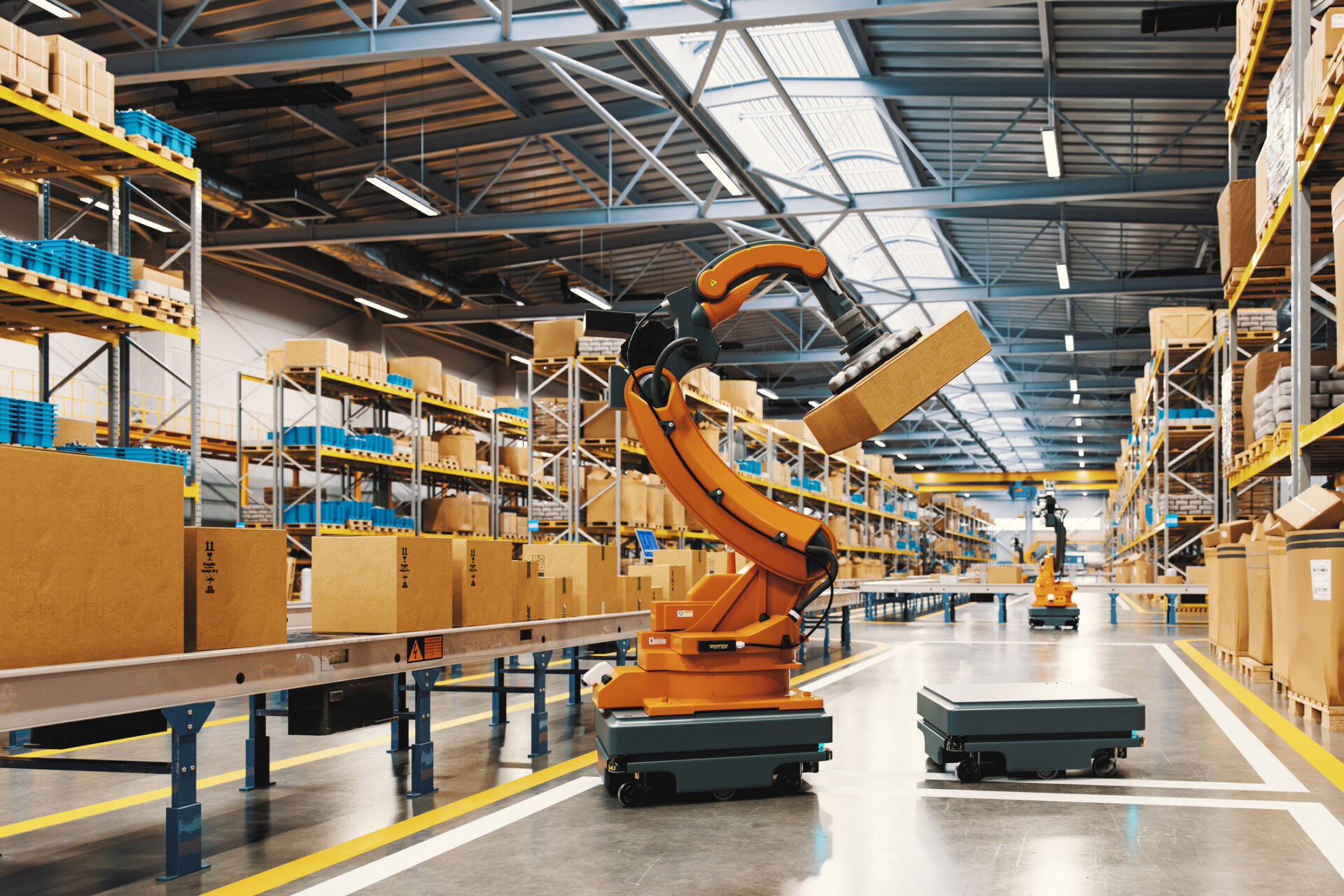
Cobots don’t just operate alongside humans—they can now operate as coordinated teams. With edge GenAI advancements being married to real-time communication and learning transfer, cobots can now work as distributed teams—coordinating tasks, sharing environmental data, and adjusting behaviors based on what their peers observe (i.e., environmental data from outside the range of their own sensors).
For example, if one cobot detects a blocked aisle or hardware issue, it can notify others to reroute or reassign tasks. These local networks function as collaborative meshes—decentralized, resilient, and increasingly autonomous.
AI makes this coordination possible, but it also introduces new performance demands: communication must be fast, decision-making must be distributed, and perception and analysis must remain sharp even in the absence of external connectivity.
Why Edge AI Hardware Matters
Running AI at the edge takes more than just sophisticated models—it requires hardware built to handle real-time inference within tight power, space, and thermal constraints. Cobots need to execute multiple workloads in parallel, from perception and motion planning to language understanding and safety checks, all without relying on cloud connectivity.
This is where the robot’s AI system-on-chip (SoC) architecture becomes critical. The ideal SoC must offer high AI performance per watt, integrate smoothly into compact robotic systems, and support the multimodal sensing and GenAI-based reasoning and decision-making tasks that define modern cobot mobility and operation.
Ambarella’s edge AI SoCs are optimized for these needs, combining advanced vision processing, multimodal sensor fusion, and low-latency inference within a compact, energy-efficient design. Whether deployed in mobile platforms (AMRs) or robotic arms, they enable cobots to make intelligent decisions locally and maintain autonomy, even in bandwidth-constrained environments. For mobile cobots, that power efficiency also helps extend battery life, which enables more efficient operations in use cases like factories.
Built for the Real World
Deploying cobots into human environments—e.g., homes, hospitals, and industrial sites—means solving for more than just intelligence. It requires platforms that are compact, energy-efficient, and robust enough to handle edge AI workloads without sacrificing overall system performance.
Customers are leveraging Ambarella’s CV7x and N1x Edge AI SoC families to address this challenge to deliver:
- High AI performance per watt, optimized for real-time computer vision tasks like semantic segmentation and depth estimation, combined with lightweight GenAI vision-language models
- Compact form factors, ideal for articulated arms, AMRs, and other space-constrained systems
- Multi-modal sensor fusion, enabling cobots to leverage data from a diverse range of inputs for a more comprehensive understanding of their environment and surroundings
- On-device inference, enabling autonomy and safety-critical decision-making without relying on cloud connectivity—including on-device GenAI.
These capabilities make Ambarella’s Edge AI SoCs well-suited to the demands of cobots operating in real-world scenarios—where power, safety, and responsiveness are non-negotiable.
Whether you’re building the next wave of cobots, designing systems that integrate teams of robots, or seeking high-performance AI hardware for similar new product platforms, we invite you to contact us.
Learn more at our AIoT, Industrial & Robotics products page.